I am learning flutter from JustAcademy, They provide very much great environment where people gather and work simultaneously. totally project based training institute.
MOHD ABU BAKAR ANSARI
Flutter Developer
Awesome Experience. I am a Front-end Web Designer working at Star India for 3 years now. I applied for Full-stack development and my experience has been phenomenal & they really do help with placements exceptionally. Thank you Roshan sir so much.
A practical comparison for Pune based learners choosing between MERN and Java full stack development, covering salary, learning curve, job roles, and long term career growth.
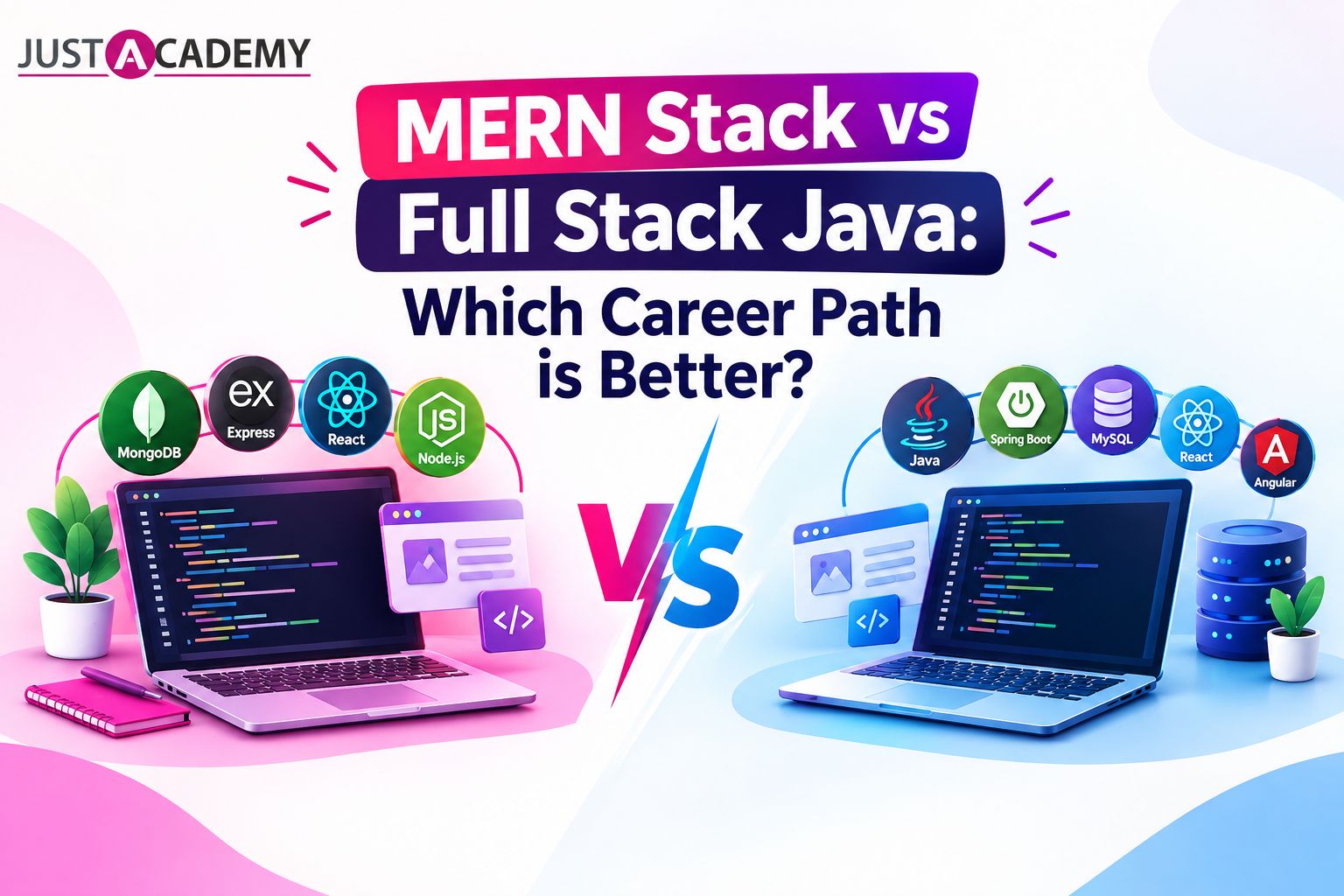
If you have spent even a week scrolling through job listings on LinkedIn or Naukri, you have probably noticed the same debate popping up again and again: mern stack vs java full stack, which one should you actually learn. It is not a silly question either. Both paths lead to real, well paying jobs, but they ask very different things of you as a learner, and they open different doors depending on the kind of company you eventually want to work for. Startups building fast moving products tend to lean on MERN, while large enterprises, banks, and product companies with legacy systems still run heavily on Java. So the "better" path genuinely depends on where you want to land.
This is exactly the kind of decision where a little structured guidance goes a long way, especially if you are based in Pune and trying to figure out whether to study locally or go the classroom route in Mumbai. If the startup, product building world appeals to you, Pune learners can look into the MERN stack developer bootcamp, and if enterprise grade backend work sounds more like your pace, the full stack Java developer bootcamp covers that path in equal depth, both with real project work rather than isolated topic lectures.
Now let us actually get into the meat of this comparison, because there is a lot to unpack when you are choosing between a full stack developer career built on MERN versus one built on the Java ecosystem.
Understanding Full Stack Development in Today's Job Market
A full stack developer, in the simplest terms, is someone who can work on both the part of the application users see and interact with, and the part that runs behind the scenes, handling data, logic, and server operations. What has changed over the last few years is how companies define this role. It is no longer enough to just know a frontend framework and a database. Recruiters now expect familiarity with deployment, basic DevOps concepts, API design, and increasingly, some exposure to cloud platforms.
Why Full Stack Roles Are in Such High Demand
Companies, especially startups and mid sized product firms, prefer hiring full stack developers because it is simply more cost effective than hiring separate frontend and backend specialists for every small team. One person who can move fluidly between the browser and the server reduces communication overhead and speeds up development cycles. This demand has only grown as more Indian companies build in house tech teams rather than outsourcing development work.
How Pune's Tech Ecosystem Shapes This Demand
Pune has quietly become one of India's strongest tech hubs, home to everything from large IT services companies to a growing number of product startups in fintech, edtech, and SaaS. This mix means that both MERN and Java full stack developers find steady opportunities here, but the flavor of the job differs. Service based companies in Hinjewadi and Kharadi often still prefer Java heavy backend teams, while newer startups around Baner and Viman Nagar tend to build their products on JavaScript heavy stacks like MERN.
What is MERN Stack and Why It Is Booming Among Pune Developers
MERN stands for MongoDB, Express.js, React, and Node.js. What makes this combination attractive is that it uses JavaScript across the entire application, from the database queries to the server logic to the user interface. There is no context switching between languages, which genuinely speeds up learning and development.
The Role of React and JavaScript in MERN
React sits at the frontend of this stack and has become almost the default choice for building interactive user interfaces. If you are exploring this path, a solid javascript training course is really the right starting point, since React, Node, and even MongoDB queries all lean heavily on strong JavaScript fundamentals. A lot of learners jump straight into a react js bootcamp without this base and end up struggling with concepts like closures, promises, and asynchronous behavior later on. Getting comfortable with a javascript course first genuinely saves time down the line.
MongoDB and the Shift Toward Flexible Databases
Unlike traditional relational databases, MongoDB stores data in flexible, JSON like documents. This makes it particularly suited to applications where the data structure evolves quickly, which is common in early stage startups. Learning mongodb database concepts, along with how a mongodb cluster is set up and scaled, is a core part of becoming job ready as a mern developer. Companies also value candidates who understand basic mongodb online administration, not just query writing.
Why Startups and Product Companies Favor MERN
Startups move fast, and mern full stack development supports that pace because a small team can own the entire application without needing separate specialists. If you look at recent hiring trends, our detailed breakdown of mern stack developer skills companies look for in 2026 goes deeper into exactly what recruiters are screening candidates for right now, and it is worth a read if you are seriously considering this path.
What is Full Stack Java and Why Enterprises Still Rely On It
On the other side, full stack java combines core Java and advanced Java for backend logic, typically with the Spring and Spring Boot frameworks, alongside a frontend technology like React or Angular. Java has been around for decades, and that longevity is precisely why it remains deeply embedded in banking systems, insurance platforms, telecom infrastructure, and government projects.
Core Java Fundamentals Still Matter
Before anyone touches Spring Boot, they need a genuinely solid grip on java basics for beginners: object oriented programming, exception handling, collections, and memory management. Employers frequently test candidates on data structures and algorithms in java during interviews, not as a formality, but because writing efficient, scalable backend code depends on this foundation. A java full course that skips these fundamentals to rush into frameworks tends to produce developers who can follow tutorials but struggle with real problem solving.
Spring Boot and Enterprise Grade Backend Development
Spring Boot has essentially become the industry standard for building Java backends because it removes a lot of the boilerplate configuration that older Java frameworks demanded. Within this ecosystem, spring security in spring boot is a topic every serious backend developer needs to understand, since it handles authentication, authorization, and protection against common vulnerabilities. Companies dealing with sensitive data, particularly in finance and healthcare, specifically look for candidates comfortable with spring security concepts during technical rounds.
Databases in the Java Ecosystem: MySQL and PostgreSQL
Java backends typically pair with relational databases, and learning mysql alongside postgresql gives you flexibility across different employer tech stacks. Unlike MongoDB's document model, these are structured, table based systems that enforce strict data relationships, which many enterprise applications require for consistency and auditing purposes. Getting comfortable with both flavors of database early on tends to make Java developers more versatile when they eventually move between service based projects and product companies.
MERN Stack vs Full Stack Java: Head to Head Comparison
Numbers and side by side comparisons often make this decision clearer than paragraphs of explanation. Here is how the two stacks stack up against each other across the factors that actually matter to someone choosing a career path.
Factor
MERN Stack
Full Stack Java
Primary Language
JavaScript throughout
Java for backend, JavaScript for frontend
Learning Curve
Faster initial progress
Steeper due to OOP depth
Best Suited For
Startups, fast moving products
Enterprises, banking, large scale systems
Database Type
MongoDB, NoSQL, flexible schema
MySQL, PostgreSQL, structured relational
Job Availability
Growing rapidly, especially in startups
Consistently high, especially in service companies
Average Fresher Salary in India
4 to 7 LPA
4 to 6.5 LPA
Long Term Scalability
Strong for modern web apps
Extremely strong for mission critical systems
Framework Maturity
React and Node, actively evolving
Spring Boot, highly mature and stable
Neither column is objectively "better" across every row, which is really the whole point of this comparison. The right choice depends on what kind of company culture and problem solving you enjoy.
Look closely at the learning curve and job availability rows together, because they tend to influence each other more than people expect. A faster learning curve means you can start applying for junior roles sooner, but it also means the applicant pool is larger, since more people can reach entry level competency in a shorter time. Java's steeper curve filters out a portion of casual learners early, which occasionally works in favor of those who push through, since fewer candidates make it to the interview stage with genuinely strong fundamentals. This is not a reason to avoid MERN, but it is a factor worth weighing if you are choosing a stack purely based on how quickly you think you can get hired.
The database row also deserves a second look, because it often shapes your daily work more than the frontend framework does. MongoDB's flexible schema is wonderful for rapid prototyping and applications where requirements shift often, but that same flexibility can create data consistency headaches at scale if a team is not disciplined about schema design. MySQL and PostgreSQL, on the other hand, enforce structure from day one, which slows down initial development slightly but prevents a lot of messy data issues later. Neither approach is inherently wrong, they simply suit different kinds of products.
Salary Expectations and Job Roles for MERN vs Java Developers
Money is naturally a big part of this decision, and it is worth being honest about where each stack currently stands in the Indian job market rather than relying on vague generalizations.
Fresher Salary Ranges and Growth Trajectory
A fresher backend developer entering the field through MERN can typically expect starting packages in a similar range to Java freshers, though MERN roles in well funded startups occasionally offer slightly faster salary growth tied to equity or performance bonuses. Java developers, particularly those who join large service based companies, tend to have more predictable, structured salary increments tied to experience bands and certifications.
Common Job Titles You Will Encounter
For MERN developers, expect titles like full stack react developer, mern developer, or javascript full stack engineer. For Java candidates, titles range from java full stack developer to backend engineer, with senior roles eventually moving toward java certification holders taking on architect or tech lead positions. Both paths eventually converge at senior engineering and architecture roles regardless of which stack you started with.
Front End, Back End, and the UI UX Connection
Regardless of stack, understanding front end back end ui ux collaboration matters more than most beginners realize. A developer who understands how design decisions affect backend performance, or how api response times affect frontend user experience, tends to get promoted faster than someone who only focuses narrowly on their assigned layer.
Learning Curve: Which Stack is Easier for Beginners
This is probably the single most common question from people starting out, and honestly, the answer is not as clean as most blogs make it sound.
Why MERN Often Feels More Approachable Early On
Since MERN uses JavaScript across the entire stack, beginners avoid the mental overhead of switching between languages while learning. If you already know how to build web application interfaces with HTML, css training, and bootstrap training basics, picking up React and eventually Node feels like a natural progression rather than starting from zero. Some learners also come in with a background in Python, having picked it up through a python training course for data or scripting work, and while Python is not part of either stack directly, the programming logic and problem solving habits it builds do transfer well into both MERN and Java full stack learning.
Why Java Demands More Discipline Upfront
Java, being strongly typed and deeply rooted in object oriented principles, asks for more patience before you see visible results. However, this discipline pays off later, particularly in interviews where data structures and algorithms in java come up constantly. Developers who push through this steeper initial curve often report stronger long term problem solving skills.
Which is Better MERN Stack or Java Full Stack for Absolute Beginners
If your goal is to build a working web app creation portfolio quickly and start freelancing or applying for junior roles within a few months, MERN generally gets you there faster. If your goal is a long term career in large, stable organizations with structured growth paths, investing the extra time in Java full stack training tends to pay dividends over a five to ten year horizon.
Career Growth and Future Scope of Both Stacks
Neither stack is going anywhere anytime soon, but the shape of growth differs meaningfully between them.
MERN's Trajectory Toward Mobile and Beyond
One underrated advantage of starting with MERN is how naturally it extends into mobile development. Since React shares core concepts with react native course material, developers often pivot into building react native mobile application projects without learning an entirely new language. This mern for beginners to mobile developer path has become increasingly common, and it is something we cover in more depth in our guide on the mern stack developer roadmap for 2026, which maps out exactly how this progression tends to unfold across two to three years.
Java's Continued Dominance in Enterprise Systems
Java is not a trendy choice, but that is precisely its strength. Banking systems processing millions of transactions daily, insurance platforms, and government infrastructure are unlikely to migrate away from Java anytime soon, given the cost and risk involved. This makes java training and a genuine java certification a fairly safe long term investment, particularly for learners who value job stability over rapid startup style growth.
Preparing for Interviews on Either Path
Whichever stack you choose, interview preparation looks different depending on the role. If Java is your direction, our compiled resource on full stack Java interview questions for freshers and experienced developers covers the exact kind of questions companies in Pune and Mumbai are currently asking, from core concepts through Spring Boot and spring security scenarios.
Freelancing and Independent Project Opportunities
It is also worth mentioning how each stack performs outside the traditional employment route. MERN developers often find it easier to pick up freelance work building landing pages, e-commerce fronts, and small business applications, partly because the tooling is lightweight and clients rarely demand the kind of enterprise grade architecture that Java projects require. Java developers, on the other hand, are less commonly seen in small freelance gigs, but they command strong consulting rates on larger contract projects involving system migrations, API integrations, or modernizing legacy applications for established businesses. If a flexible, project based income stream alongside your main job appeals to you, MERN tends to offer more immediate opportunities, while Java rewards patience with higher value, longer term contracts.
Which Stack Should Pune Based Developers Choose
Given everything above, how should someone actually sitting in Pune, weighing local job openings and salary trends, make this call?
Local Hiring Trends Worth Watching
Pune's IT corridor, particularly around Hinjewadi, Magarpatta, and Kharadi, continues to see steady demand for both stacks, though larger MNCs and service companies in these areas skew toward Java heavy backend requirements. Meanwhile, the growing startup pockets across Baner, Aundh, and Viman Nagar are more likely to be hiring for mern stack roles, especially for product based teams building consumer facing applications.
Matching the Stack to Your Career Goals
If you are drawn toward working at a large, established company with structured career ladders, full stack java training positions you well for that path, whereas the MERN route is worth exploring if a startup, product driven environment sounds more appealing instead, since it is built specifically around the kind of applications for web design and rapid iteration that startups expect from new hires.
Tools and Daily Workflow: What a Real Working Day Looks Like
Comparisons on paper are useful, but they rarely capture what actually happens once you are sitting at your desk writing code for a real employer. Understanding the day to day workflow of each stack can make the decision feel a lot less abstract.
A Typical Day as a MERN Developer
A MERN developer's day usually starts with checking pull requests and picking up tickets from a project board, often built around agile sprints. Much of the work involves building or modifying React components, wiring them to Express based APIs, and testing how data flows from the mongodb database through the backend and into the interface. Debugging tends to happen across the browser console and server logs simultaneously, since JavaScript runs on both ends. Deployment pipelines in MERN heavy teams are often lightweight, with frequent, smaller releases rather than large infrequent ones, which suits the fast iteration culture common in startups building consumer facing applications for web design and mobile experiences alike.
A Typical Day as a Java Full Stack Developer
A Java full stack developer's day, particularly in enterprise settings, often involves more formal code review processes and stricter testing requirements before anything reaches production. Working with Spring Boot means dealing with layered architecture, service classes, repository patterns, and often more extensive unit testing using frameworks tied into the Java ecosystem. Because many Java shops handle sensitive data, spring security configuration, logging, and audit trails are treated as first class concerns rather than afterthoughts. Release cycles tend to be longer and more controlled, reflecting the higher stakes of the systems being maintained, whether that is a banking platform or an insurance claims engine.
Collaboration Style and Team Structure Differences
MERN teams, especially in startups, are frequently smaller and flatter, meaning a single full stack react developer might genuinely own a feature end to end, from database schema to the final UI polish. Java teams in larger enterprises tend to be more specialized even within the full stack label, with clearer boundaries between backend services, frontend teams, and dedicated QA or DevOps groups. Neither structure is better for everyone, some developers thrive with the ownership and pace of a small MERN team, while others prefer the depth and specialization that larger Java driven organizations offer.
Why Structured Training Matters for MERN and Java Full Stack Learners
Self teaching from scattered YouTube tutorials and random blog posts can only take you so far, and this is where structured, mentor led training genuinely changes outcomes. At JustAcademy, learners get access to live interactive sessions, not pre recorded videos, which means you can ask questions in real time and actually understand concepts like website development software workflows or how java certification exams are structured, rather than guessing your way through documentation alone.
JustAcademy, as an ISO certified training institute, runs classroom based programs from its branches in Mumbai and Pune, alongside live interactive online courses accessible to learners anywhere in the world. This dual format means Pune based students are not limited to only local batches, they can also join instructor led online cohorts covering the exact same curriculum taught in the Mumbai classrooms, with mentor led doubt solving built into every session. Whether you choose MERN or Java, every program includes placement support, helping learners transition from coursework to actual job interviews with resume reviews, mock interviews, and direct connections to hiring partners. This structured, live interactive training approach is consistently cited by our alumni as the difference between finishing a course and actually landing a job offer.
Conclusion
So, mern stack vs java full stack, which one genuinely wins? Honestly, there is no universal winner here. MERN suits learners who want a faster entry into frontend heavy, JavaScript centered roles and eventually want the option to pivot into mobile development through react native. Full stack Java suits learners who are comfortable investing more time upfront in exchange for deep, stable, enterprise grade career opportunities that remain in demand across banking, insurance, and large scale product companies for the foreseeable future. Both are legitimate, well paying full stack developer career paths, and the best course in mumbai and Pune for either one comes down to finding training that offers live interactive sessions, experienced mentors, and genuine placement support rather than just recorded content.
If you are still on the fence, the easiest next step is to experience the teaching style for yourself. Register for a free demo session and sit in on a live class before making any commitment, or download our detailed brochure to compare the full MERN and Java full stack curriculums side by side.
MERN Stack vs Full Stack Java: Head to Head Comparison
Salary Expectations and Job Roles for MERN vs Java Developers
Learning Curve: Which Stack is Easier for Beginners
Why Structured Training Matters for MERN and Java Full Stack Learners
A practical comparison for Pune based learners choosing between MERN and Java full stack development, covering salary, learning curve, job roles, and long term career growth.